
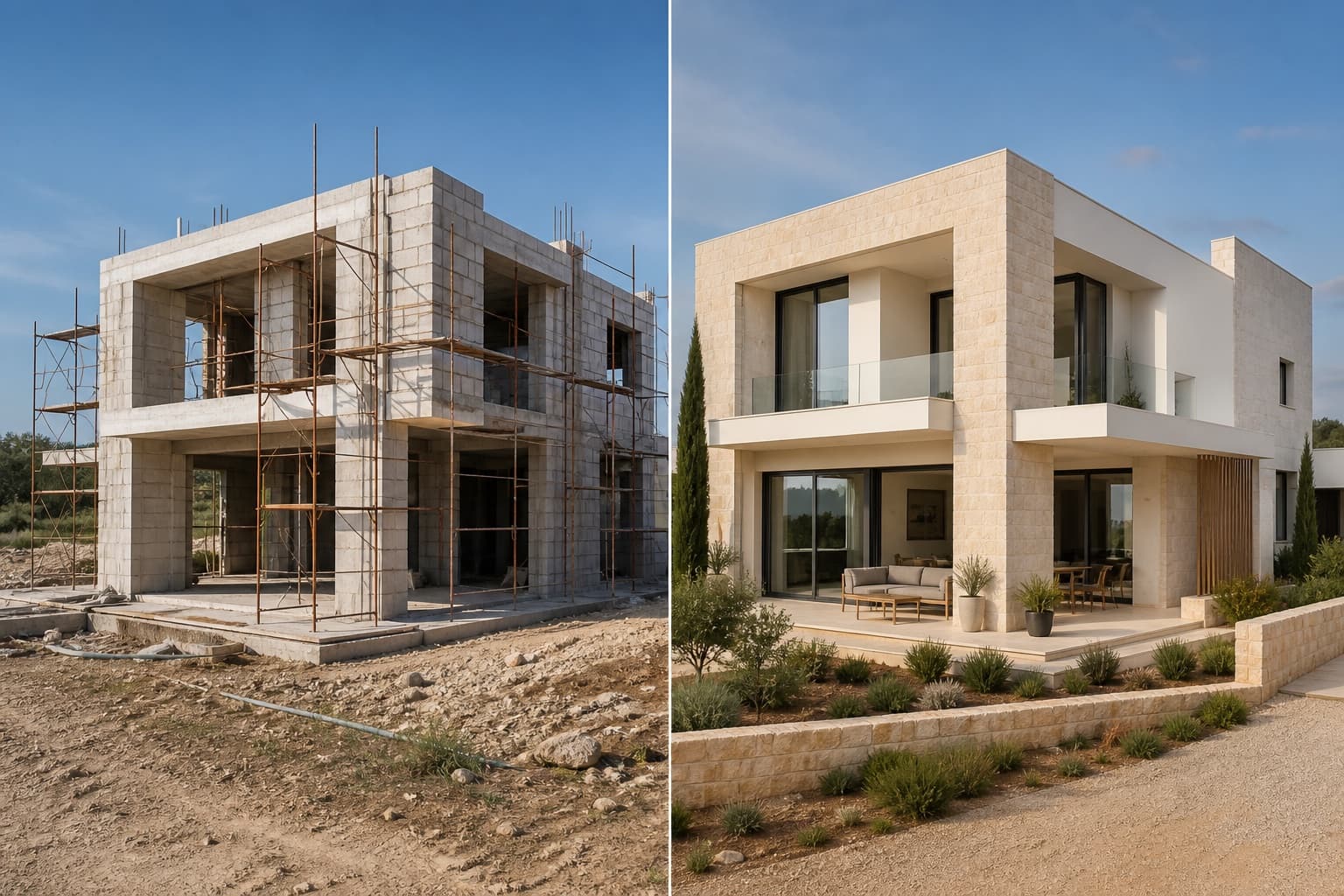
Start with exposure, not appearance
There is no single “Cyprus material”. A product that performs well inland may need a different coating or maintenance cycle beside the sea. Before specifying finishes, establish the building’s orientation, distance from the coast, wind exposure, shade, drainage and the condition of the existing structure.
The most durable specification is usually a complete system: substrate preparation, compatible primer, finish coat, correct fixings, sealed junctions and a realistic maintenance plan. Selecting only the visible finish leaves the weakest details unresolved.
External walls and finishes
Light-coloured mineral or high-quality exterior coating systems help limit solar heat absorption and make cracking easier to monitor. On older masonry, vapour-permeable finishes can be preferable to dense coatings that trap moisture, but the existing wall build-up must be assessed first.
Render should be detailed with movement joints, sound corner reinforcement, drip edges and careful interfaces around windows. Many façade failures begin at junctions rather than across the main wall surface.
- UV-stable exterior coatings
- Compatible render and reinforcement systems
- Pale colours where heat gain is a concern
- Proper drips, joints and window interfaces
Windows, doors and metalwork
Thermally improved aluminium frames with a reputable powder-coated finish are a practical option for many Cyprus properties. Glass specification, shading and installation quality matter as much as the frame: an expensive unit can still perform poorly if perimeter gaps and water paths are not resolved.
Near the coast, fixings and accessories need particular attention. Appropriate stainless-steel grades, protected cut edges and separation between dissimilar metals help reduce premature corrosion.
Roofs, insulation and waterproofing
Roof build-ups experience intense solar loading. Continuous insulation, a suitable reflective or protected waterproofing system, correct falls and unobstructed outlets are more important than any one brand name. Insulation should remain continuous at parapets and penetrations wherever the construction allows.
Flat roofs should be inspected before winter rains and after work by other trades. Small punctures, blocked outlets and failed upstands can create disproportionate internal damage.
A sensible specification process
Ask for a written system specification, not a shopping list. It should identify preparation, product layers, application conditions, fixings, junction details and maintenance requirements. Existing damp, movement or salt contamination should be investigated before finishes conceal the evidence.
Final choices should be confirmed for the actual site by the relevant designer, engineer, supplier or specialist installer. Climate-aware detailing is what turns a good material into a durable result.
Every property and exposure is different. Product selection and construction details should be confirmed for the specific building by the relevant qualified professional or specialist supplier.